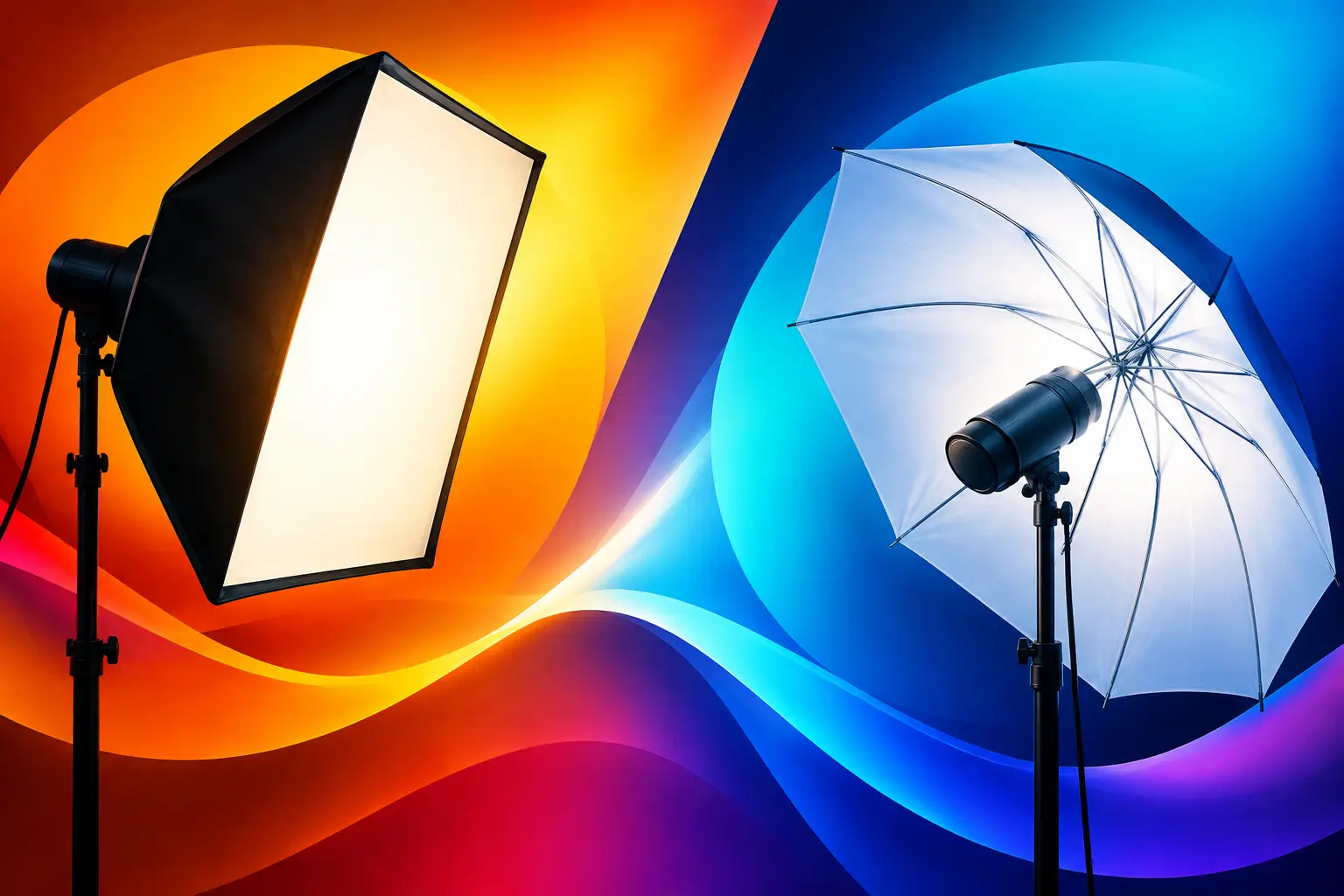
A softbox versus umbrella decision is rarely about which modifier is ‘better’. It is about what the frame needs: controlled shape, broad fill, fast set-up, spill, contrast, or a light source that can move with a changing shot list. The right choice can make a small production feel considered. The wrong one can leave product edges flat, backgrounds unintentionally bright, or a portrait without the direction the treatment calls for.
For photographers, content teams and production crews, both modifiers earn their place on set. They simply solve different problems. Start with the visual brief, then consider the room, subject, camera angle and pace of the day.
Softbox versus umbrella: the practical difference
A softbox encloses the flash or continuous fixture and sends light through a front diffusion panel. Its internal surface reflects light forwards, while the shape and recessed front help contain spill. The result is usually directional, soft light with a defined fall-off.
An umbrella is more open. A shoot-through umbrella diffuses light as it passes through the fabric, while a reflective umbrella bounces it back towards the subject. Both create a broad source quickly, but they tend to throw light more widely around the room.
That distinction matters most when the background, set build or adjacent subject needs to remain controlled. In a blackout environment, a softbox makes it easier to place light precisely and preserve negative space. In a daylight-led space, an umbrella can be useful for lifting shadows or matching the wider, more open quality of window light.
Neither modifier is inherently softer just because of its name. Softness comes primarily from the apparent size of the source relative to the subject, and from how close it sits. A large umbrella placed close can be very soft. A small softbox placed far away can look comparatively hard. The modifier changes how manageable that softness is.
Choose a softbox when control is part of the brief
Softboxes are the dependable option when the lighting needs to look intentional in camera. Their contained output is particularly useful for fashion, beauty, e-commerce, drinks, tabletop work and polished brand content.
Cleaner direction and more predictable spill
A rectangular softbox can mimic the direction of a window, making it a natural fit for portraits and editorial scenes. A strip box creates a narrow band of light that works well for rim light, reflective packshots or shaping a subject from the side. Octagonal softboxes give a rounded catchlight and an even wrap that suits headshots, beauty and talking-head video.
Because the light is less likely to bounce indiscriminately around the space, a softbox also lets you work closer to a darker, moodier exposure. You can light the talent without lifting every wall and corner behind them. Add a grid and the control becomes tighter again, useful where the frame needs separation without flare or background contamination.
Better for products with shape and texture
Product work often benefits from the defined reflections a softbox can produce. On glass, metal, cosmetics or glossy packaging, the reflection of the modifier is part of the image. A long strip box can create a clean highlight along a bottle. A large rectangular softbox can give a controlled gradient across a box or garment.
This is not always about making the product look dramatic. It is about being able to repeat the result across a range of angles and SKUs. A softbox gives the crew a more stable starting point, especially when tethered shooting, styling adjustments and client review are all happening in the same session.
The trade-off: more kit, more time
Softboxes take longer to assemble than umbrellas, particularly larger models or grid-equipped setups. They also need more clearance. On a compact set, a deep octa on a boom can quickly become the biggest object in the room.
For stills that are carefully lit, this is usually a fair exchange. For a fast-moving social shoot with multiple contributors, it may not be. The question is whether the control will show in the final crop. If the content is designed for a clean campaign asset, it usually will.
Choose an umbrella when pace and broad coverage matter
An umbrella is one of the fastest ways to turn a bare fixture into a larger, gentler source. It is lightweight, inexpensive and easy to reposition, which makes it valuable on test shoots, creator sessions, small crews and production days where the set changes frequently.
Fast light for portraits and content capture
For a simple portrait, place a large shoot-through umbrella close to the subject and slightly above eye level. It produces an open, flattering light with a quick setup. It can be a useful choice for a high-volume headshot session, informal editorial portraits or behind-the-scenes content where the crew needs to stay mobile.
Reflective umbrellas are generally easier to direct than shoot-through versions. A white reflective umbrella gives a softer, more neutral return, while silver produces a punchier output. Both can cover a broad area, helping when two people need to sit within the same pool of light or when a wider composition changes throughout the day.
Useful as fill, less exact as a key
Umbrellas are often at their best as uncomplicated fill. In a daylight space, they can lift the shadow side of a portrait without making the scene feel overly lit. For video, a large umbrella can offer a quick, soft base level where precision is less important than consistency across a conversational setup.
The compromise is spill. Light can hit ceilings, floors, side walls and backgrounds, then return to the subject from directions you did not plan. In a white studio, that can reduce contrast quickly. In a darker set, it can reveal areas meant to stay out of the exposure. Flags, negative fill and careful positioning help, but at that point a softbox may be the more efficient choice.
The trade-off: less shaping power
An umbrella can create a lovely result, but it offers less control over the exact edges of the source. There is no grid on most standard umbrellas, and the light often travels past the subject. If you need a crisp pool of light on a face, a controlled reflection on a product, or a black background that remains black, it can become a fight.
That does not make umbrellas unsuitable for commercial work. It simply means they favour a looser visual language: open portraits, natural-feeling fill, wider groups and fast setups where a little environmental bounce is welcome.
Match the modifier to the studio environment
The room is part of the lighting setup. A modifier that works beautifully in one environment can behave differently in another.
In a controlled blackout corner, the softbox has a clear advantage when you want to build the image from zero. You can place a key, introduce a rim or background light, and keep each source doing a specific job. This is especially useful for campaign portraits, product films, punchy social ads and any brief where contrast needs to hold from shot to shot.
An umbrella can still work in a dark space, particularly for a broad portrait key or a quick fill. Keep it close to the subject and watch the background. The more distance between umbrella and subject, the more likely its wide spread will reach surfaces outside the intended frame.
In a daylight studio, use natural light as the first source to assess. If the window direction already gives the image its character, an umbrella can gently soften shadows without changing the feel. If you need to introduce a distinct artificial key, control glare on a product, or keep the exposure consistent as daylight shifts, a softbox provides a more repeatable answer.
At Lit Studios, the choice maps naturally to the two working environments. The Void supports precise modifier placement and controlled contrast; The Loft leaves room for daylight-led images with added fill where needed. The brief should decide the room and the modifier together.
A simple on-set test before committing
If time allows, test both modifiers before styling is finalised. Photograph the subject from the intended camera position, not just from where the light stand is convenient. Look at the catchlights, the shadow under the jawline, background exposure and any reflections in wardrobe or product surfaces.
Move the source closer before increasing power. A closer modifier becomes larger relative to the subject, softening the transition from highlight to shadow. Then feather it – point the centre of the source slightly past the subject – to use the softer edge of the output and reduce spill.
For an umbrella, check the room as much as the subject. If the background brightens too much, reduce its distance, turn the umbrella away from the walls, or switch to a reflective version. For a softbox, test whether a grid is genuinely needed. Grids are useful, but they reduce output and can make a setup unnecessarily restrictive when the shot needs a little more wrap.
The better modifier is the one that supports the shot list
Choose a softbox when shape, repeatability and spill control matter. Choose an umbrella when you need generous coverage, speed and an open quality of light. Many efficient sets use both: a softbox as the main shaped source, an umbrella as a quick fill or a broad second light.
Before the first fixture is switched on, decide what should stay dark, what should catch the light and how quickly the set needs to turn over. That decision will tell you more than the modifier’s name ever can.
Leave a Reply